Starlink for boats in Australia: Roam, Ocean Mode & the honest verdict
No dish at all? Inside immediate offshore waters a Telstra phone on an Upfront plan can already send a text via satellite — included, but texts and a few light apps only, and not to Triple Zero. What satellite texting can and cannot do →
As at 10 October 2026, Starlink residential plans in Australia run from $75 a month (up to 100 Mbps) to $150 (uncapped, 400+ Mbps); NBN Sky Muster Plus starts around $60 through a retailer; the ACCC’s final Measuring Broadband Australia report measured Starlink at 199.1 Mbps in busy hours, while NBN Sky Muster delivered 78.5% of its plan speed; latency was last measured at 26.7 ms for Starlink and 664.9 ms for Sky Muster, in earlier reports — the final report does not measure it.
What does it actually cost? Plans, ACCC performance and the demand surcharge, in one place →
For most Australian boaters — at the marina, at anchor, day trips inside coastal waters — a standard Starlink Roam plan on a Mini is the answer, and it works today. The complications start past 12 nautical miles (you need Ocean Mode on the Unlimited plan) and underway at speed (officially, you need the expensive Flat High Performance dish). Charter and commercial operators are a different market again, with different plans and different money.
Which boater are you?
Inside 12 nautical miles — marinas, bays, anchorages, coastal cruising — standard Starlink Roam coverage applies. A Mini kit and the 100GB plan is where most recreational boaters should start. No maritime plan needed.
Beyond 12nm you need Ocean Mode (Roam Unlimited, pay-per-GB) — and for guaranteed underway use or a business-grade service, the Flat High Performance dish with Maritime priority plans, sold in Australia through resellers like Skymesh and AMI Connect.
The 12-nautical-mile rule — the single fact that decides your plan
Starlink's own support documentation draws the line clearly: standard Roam coverage includes marinas, inland waterways and coastal waters — but Ocean Mode, an opt-in available only on the Roam Unlimited plan, is what "enables coverage beyond 12 nautical miles." Ocean Mode data is billed per GB on top of the plan.
What changed in late 2026. On 27 August 2026 Starlink announced a Personal Maritime plan for private boats: unlimited data in territorial waters worldwide, Ocean Mode metered beyond that, and use on craft over 60 ft (first published as 40 ft) not allowed. It was announced at US$185 a month. At the same time Starlink told US Roam Unlimited customers that Ocean Mode data would rise from US$2 to US$6 per GB from 27 September 2026. Those are US prices. When we checked in October 2026, we could not confirm the Australian price, or whether the plan is sold here yet. Check the plan list in your Starlink account before you count on it.
In practice: if your boating happens inside territorial waters — which covers the overwhelming majority of Australian recreational boating — an ordinary Roam plan works, and the whole maritime pricing tier is money you don't need to spend. If you're crossing Bass Strait, running to the outer reef, or heading bluewater, you're in Ocean Mode or priority-plan territory. That single distinction is the honest starting point, and it's the one most sales pages skip.
Verified August 2026. Coverage rule from Starlink's own Roam service-plan documentation. Plan inclusions change; confirm at starlink.com/au before ordering.
The roaming rules changed on 17 August 2026
If you take an Australian-registered Starlink outside Australia, read this before you leave. Starlink changed its international policy for new customers on 14 July 2026, and existing customers moved onto it on 17 August 2026. Australia is its own region — unlike the US and Canada, which are grouped, or Europe — so New Zealand, Indonesia, Papua New Guinea and the Pacific all count as international from the moment you arrive.
- Roam Unlimited now includes 30 days outside your registered home country at a time, down from 60 days per trip. The window resets by returning home, or by localising the account to the new country.
- Roam 100GB and Roam 300GB no longer work internationally at all. They are limited to your registered home country. This is the change that catches people out, because it was not a limit before — it was a longer allowance.
- Global Roam is gone. The unadvertised $400/month plan that carried unlimited international land data was withdrawn from new customers on 15 July 2026, and existing subscriptions stopped on 17 August.
- Global Priority is now the only plan with no time limit on international use. It is substantially more expensive, and for a cruising boat that is the real cost of the change.
- A one-off identity check — photo ID plus a live selfie — is now part of activating international use.
None of this affects a boat that stays in Australian waters, and none of it changes the 12-nautical-mile rule below. It matters if you cross to another country and expect the same plan to keep working.
Your AMSA operational area vs the 12nm line
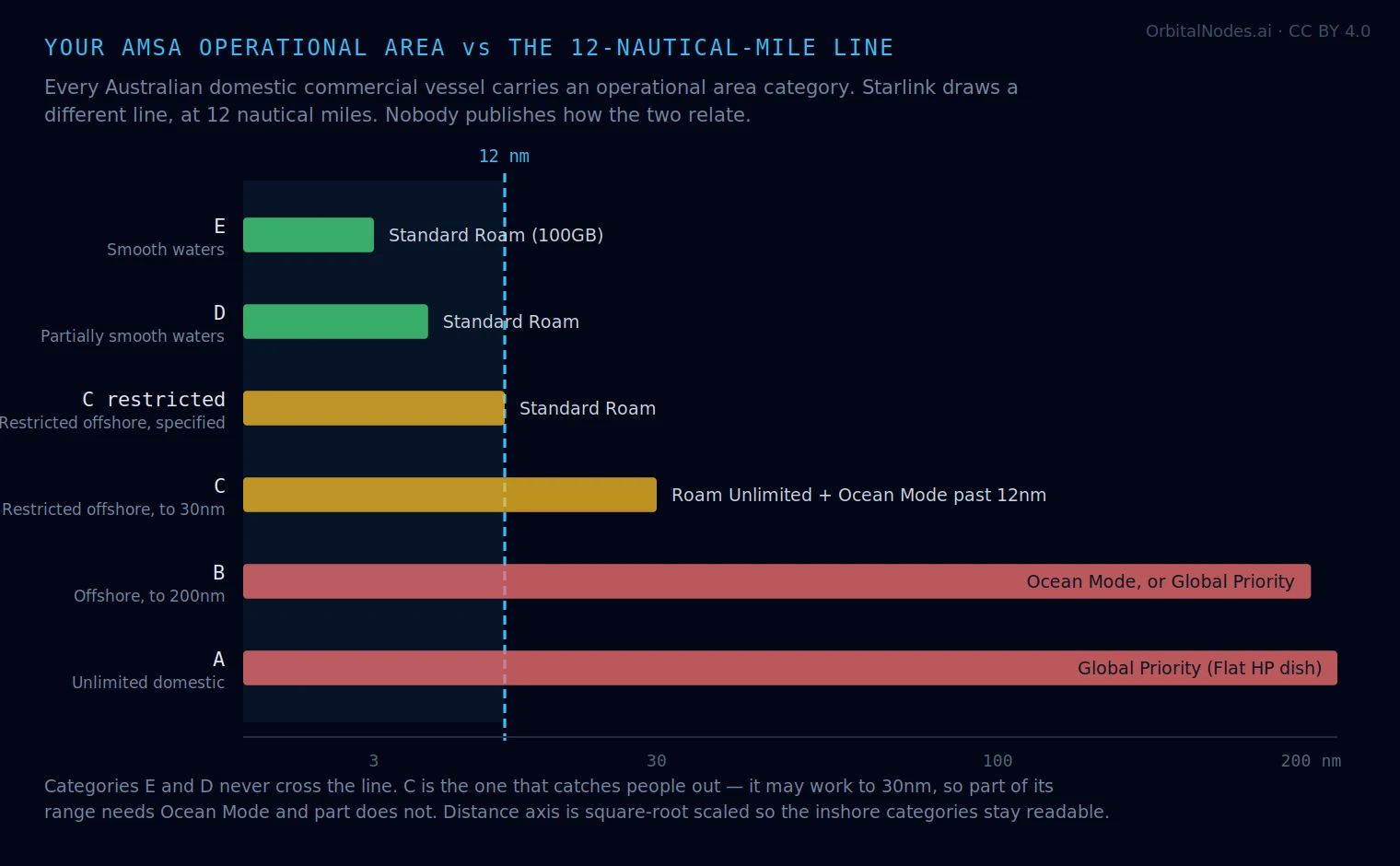
Every Australian domestic commercial vessel carries an operational area category on its certificate — AMSA’s own classification of how far offshore it may legally work. Starlink draws a different line, at 12 nautical miles. Nobody publishes how the two relate, so we’ve mapped them.
| AMSA operational area | What it means | Crosses 12nm? | What actually works |
|---|---|---|---|
| E | Smooth waters (boundaries set by your state) | No | Standard Roam (100GB) |
| D | Partially smooth water operations (state-defined) | No | Standard Roam |
| C restricted | Restricted offshore, specified areas (Exemption 40); varies by state and vessel length | Rarely | Standard Roam |
| C | Restricted offshore operations, within 30 nautical miles of shore | Partly | Roam Unlimited + Ocean Mode past 12nm |
| B | Offshore operations, out to 200 nautical miles | Yes | Ocean Mode, or Global Priority |
| A | Unlimited domestic operations | Yes | Global Priority (Flat HP dish) |
These plan recommendations are for Australian waters, which is what an AMSA operational area describes. If you cross to another country, the roaming limits above apply on top: Roam 100GB and 300GB stop working internationally, and Roam Unlimited gives you 30 days at a time.
The operational-area definitions are AMSA’s. The mapping to Starlink’s coverage is ours — AMSA does not define its areas against the 12nm territorial-sea limit, and D and E boundaries are set state by state. Treat this as a planning guide, not a compliance document.
The category that matters most is C. A vessel certificated to work within 30 nautical miles of shore can legally operate well past the 12nm line where standard Roam coverage stops — so the plan that covers the inner half of its range does not cover the outer half. That is the single most common mismatch on Australian working boats, and it is invisible until you are out there.
It is not a niche problem either. In AMSA’s own fleet survey, operational area C accounted for 32.5% of the domestic commercial fleet — roughly a third of Australia’s working vessels are certificated for waters that cross the boundary.
Sources. Operational area categories A–E per AMSA and NSCV Part B; category C described by AMSA as restricted offshore operations within 30 nautical miles of shore; C restricted areas set under Exemption 40. Fleet proportion by operational area from AMSA’s domestic commercial vessel survey. The 12nm figure is Starlink’s, from its Roam service-plan documentation.
Who is actually out there
Australia’s domestic commercial fleet runs to around 31,000 active vessels across 61 vessel classes, from kayaks and hire-and-drive tenders through to trawlers and passenger ferries over 45 metres. 58.8% of the active fleet is under 7.5 metres — small boats, working close to home, for whom a Mini on a Roam plan is genuinely the whole answer.
The fleet is not evenly spread, which is why the shore-side pages below matter differently depending on where you are. Queensland holds the largest share of the certificated fleet at 35.3%, followed by New South Wales at 26.7% and Western Australia at 11.2%. Non-passenger vessels are the largest class in every state except South Australia and Tasmania, where fishing vessels lead — a different connectivity problem, further offshore, for longer.
For scale: that fleet works a coastline of 60,000 kilometres taking in 12,000 islands, inside the world’s third-largest exclusive economic zone.
Source: AMSA, May 2021. Fleet distribution by state, class and length from AMSA’s MARS system as reported in its domestic commercial vessel fleet profile; national fleet size and coastline figures from AMSA’s operating environment snapshot. These are the most recent figures AMSA publishes in this form — they are several years old and the fleet has changed since.
Your options on the water, compared
| Option | Where it works | Real-world speed | Underway? | Data | Hardware | Monthly |
|---|---|---|---|---|---|---|
| Roam 100GB | Marinas, anchorages, coastal (inside 12nm) | SpaceX estimates 65–260 Mbps down | Not officially supported on standard dishes | 100GB high-speed, then unlimited low-speed | Mini ($599 RRP) or Standard | $85 |
| Roam Unlimited | As above, plus offshore via Ocean Mode | Same — data cap is the only difference | Not officially supported on standard dishes | Unlimited coastal; Ocean Mode billed per GB past 12nm | Mini or Standard | $210 + Ocean Mode data |
| Maritime / Global Priority | Global oceans, all conditions | up to 220 Mbps down (Flat HP) | Yes — in-motion at speed, officially supported | Priority blocks: 50GB up to 2TB | Flat High Performance kit, around A$3,740 | from A$450 (50GB) to A$3,870 (2TB) |
Verified August 2026. Roam pricing in AUD per Starlink's June 2026 Australian price change ($85 / $210; Standby now $15 and stationary-only). Maritime figures are Starlink's Global Priority tier in Australian dollars (Canstar, April 2026); add-on data blocks from A$180 per 50GB. Resellers may bundle or vary this — confirm before committing. We take no payment to rank any option.
The honest catches nobody puts on the brochure
Underway is the grey zone. Starlink's customer documentation for Roam describes a portable service, and the standard residential-style dishes are known to shut down when they detect sustained motion. Plenty of Australian boaters report a Mini working fine on a slow displacement hull — but it is not the supported configuration. The supported underway path is the Flat High Performance dish, and that's a serious investment in hardware and power draw (roughly twice a standard dish — a real issue on battery and solar boats).
Weather is real. Heavy rain and storm cells cause temporary dropouts on any satellite service. Starlink at sea is excellent; it is not an emergency communications device and shouldn't replace your EPIRB, VHF or sat phone for safety-of-life.
Standby Mode changed in March 2026. It's now $15/month and stationary-only — it disables when the dish detects movement. It remains a good way to park your subscription cheaply between trips, but it is not cut-price underway internet.
The two-month overseas rule. Roam supports international use for up to two months continuously; long cruising passages beyond that mean transferring your service region — or a Global Priority plan, which has no such limit.
Charter, fishing & commercial — where the maritime plans actually belong
The Maritime / Global Priority tier exists for vessels where connectivity is a business input: charter boats keeping guests streaming, commercial fishing fleets, offshore industry, research vessels. Priority data holds its speed under congestion and works mid-ocean and in motion at any vessel speed, and up to two terminals can share a service line on one vessel.
In Australia these plans are sold and supported through resellers — Skymesh (Brisbane-based support, nationwide installer network, cyclone-rated mounting) and AMI Connect with Castor Marine (integration with existing VSAT/4G systems) are the established options. For a working vessel, a reseller relationship means local invoicing, professional installation and a human to call — genuinely worth it at this tier, in a way it isn't for a weekend tinnie.
Where to buy — matched to what you actually are
Where to buy
How we make money: none of the links below earn us anything at the moment. If that changes, this note will say which do — and it will never change what we recommend, or the order options appear in. Starlink pays us nothing. Read the full policy.
Shore-side: the ports and coastal towns, assessed
Cruising is half on the water and half alongside — and shore-side options vary enormously between an east-coast marina town and a remote western port. We assess every one of these with verified NBN and mobile-tower data:
Queensland reef & islands run: Cairns · Townsville · Mackay (Whitsundays gateway) · Rockhampton / Keppel · Bundaberg (Lady Musgrave) · Brisbane / Moreton Bay
NSW & east coast: Sydney · Coffs Harbour
Southern waters: Hobart · Launceston / Tamar · Adelaide / Gulf St Vincent · Port Augusta · Ceduna
West & north: Perth / Fremantle · Bunbury · Albany · Esperance · Geraldton (Abrolhos) · Karratha / Dampier · Darwin
Common questions — Starlink on the water
Does Starlink work on a boat in Australia?
Yes. Inside coastal waters (12 nautical miles), standard Starlink Roam coverage includes marinas, inland waterways and coastal cruising — a Mini on a Roam plan is how most Australian recreational boats run it. SpaceX estimates Roam at 65–260 Mbps down and 15–35 Mbps up — at anchor with a clear sky, it performs like a good home connection. Beyond 12nm requires Ocean Mode on the Roam Unlimited plan, billed per GB.
Can I use Starlink while the boat is moving?
Officially, guaranteed in-motion marine use requires the Flat High Performance dish on a priority plan. Standard dishes can shut down when they detect sustained motion, though many owners report a Mini working on slow hulls. If underway connectivity matters commercially, use the supported hardware.
What does Starlink cost for a recreational boat?
Roam 100GB is $85/month and Roam Unlimited is $210/month (Australian pricing after the June 2026 change), plus the Mini kit at $599 RRP. Ocean Mode data for offshore passages is charged per GB on top of Roam Unlimited. Standby Mode ($15/month, stationary-only) parks the subscription between trips.
What about charter boats and commercial vessels?
That's the Maritime / Global Priority tier: priority data blocks from 50GB to 2TB monthly (A$450 to A$3,870 in Australia, with add-on blocks from A$180 per 50GB), the Flat High Performance dish, official in-motion support and global ocean coverage. In Australia these are sold with local support through resellers such as Skymesh and AMI Connect.
Which Starlink plan does my AMSA operational area need?
Areas D and E sit inside sheltered waters, so standard Roam covers them. Area C allows work within 30 nautical miles of shore — that crosses Starlink’s 12 nautical mile boundary, so the outer part of your range needs Ocean Mode on Roam Unlimited. Areas B and A operate well beyond it and suit Global Priority. AMSA defines the areas; the mapping to Starlink coverage is ours.
Will Amazon Leo work for boats?
Not at launch. Amazon Leo's initial Australian service is residential/fixed via its NBN partnership, and a maritime product hasn't been announced. Starlink took years to build its marine capability; treat Leo-at-sea as a later chapter, not a reason to wait.