Location
Australia
In remote and much of regional Australia, satellite is often the genuine best option — not a fallback.
Starlink is the main satellite broadband option across regional Australia, with NBN Sky Muster Plus the long-standing alternative. Plan prices are national; what varies by address is whether a demand surcharge applies and how the local cell is loaded.
Enter your postcode and we'll take you to the right assessment.
What Starlink delivers in Australia: ACCC-measured speeds around 200 Mbps down and latency near 27 ms, available nationwide today. Where fixed-line or fixed-wireless NBN reaches, it usually wins on price; beyond the grid, Starlink is the strongest option now — with NBN’s Amazon Leo reaching first customers from around mid-2027 as the low-earth-orbit alternative.
What it all costs, on the government’s own ACCC numbers →
Answer three quick questions for an honest starting point. This is a guide, not a live address check — always confirm availability and pricing at your exact address before ordering.
1. Where are you?
2. What matters most?
3. How heavy is your use?
If fixed-line NBN is available it will almost always beat satellite on price and consistency. Many premises now eligible for free/subsidised FTTP upgrade. Check your address at nbnco.com.au.
Available Australia-wide today; the practical LEO option now.
Not yet orderable in AU; arriving via NBN partnership. See arrival estimate.
GEO satellite (660ms latency, ACCC-measured); Starlink beats it on latency. Being replaced by Amazon Leo from 2026 — see migration guide.
| Plan | Monthly |
|---|---|
| Ultra25 (up to 25 Mbps) | A$59.95 first 6mo, then A$69.95 |
| Ultra50 (up to 50 Mbps) | A$74.95 first 6mo, then A$89.95 |
| Ultra100 (up to 100 Mbps) | A$99.95 first 6mo, then A$109.95 |
| Plan | Monthly | Notes |
|---|---|---|
| Residential 100 Mbps | A$75 | up to 100 Mbps; entry tier |
| Residential 200 Mbps | A$110 | up to 200 Mbps |
| Residential Max | A$150 | up to 400+ Mbps; includes optional mesh node |
Same sky, three different products. The right one depends on you, not on us.
A large share of premises here are primary-producer or business sites — and that changes the best path. Starlink Business via Skymesh adds what a working property actually needs: professional installation (no climbing the shed roof yourself), Brisbane-based support plans up to 24/7, hardware leasing instead of upfront outlay, and consolidated invoicing across multiple sites. Skymesh Starlink Business →
How we make money: none of the links below earn us anything at the moment. If that changes, this note will say which do — and it will never change what we recommend, or the order options appear in. Starlink pays us nothing. Read the full policy.
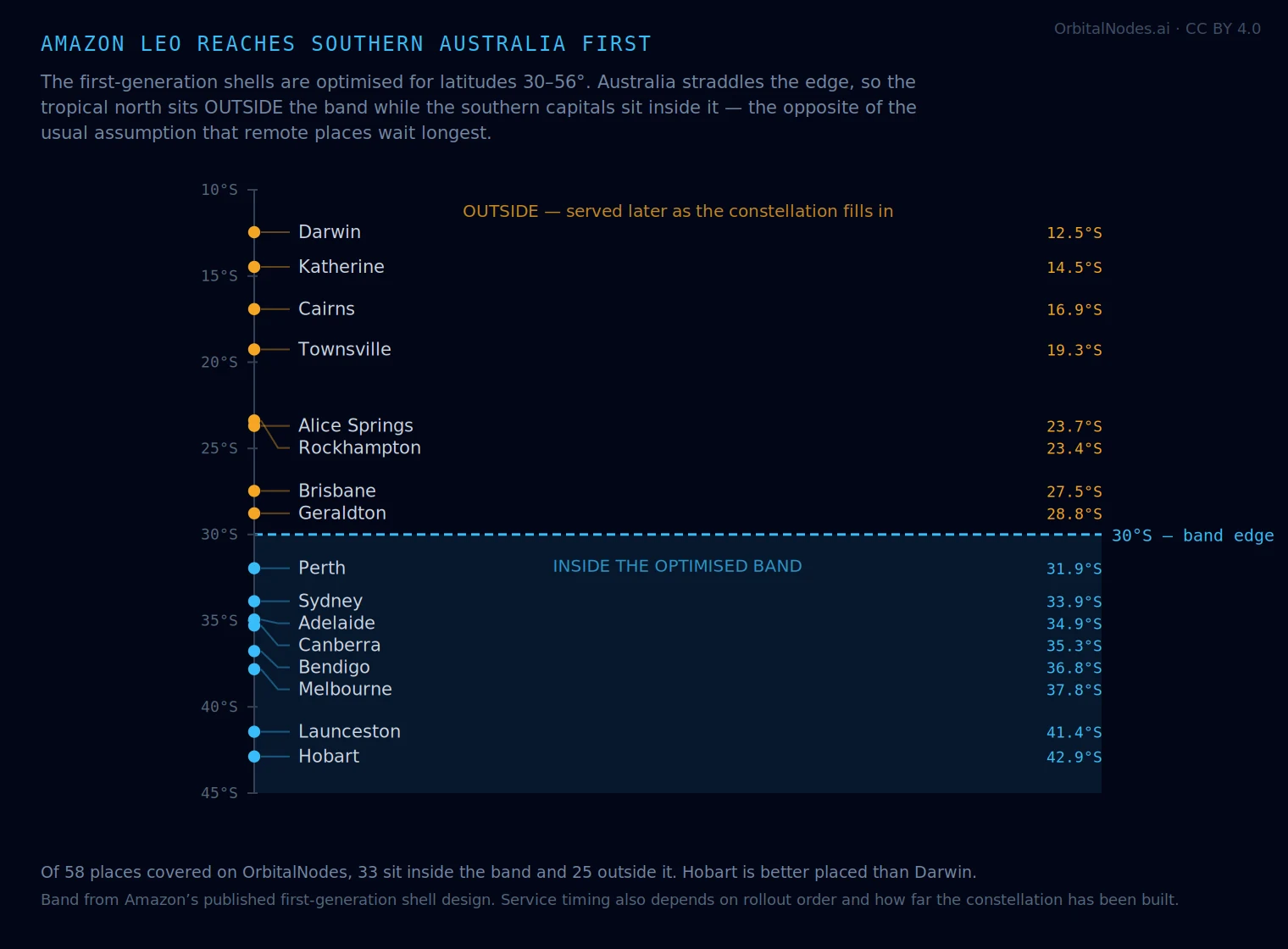
Amazon Leo's first-generation shells are tuned for the mid-latitudes, and the network switches on in stages as satellites launch. Three things set the timing for any one place: how well its latitude fits the coverage band, where its country sits in Amazon's rollout order, and how far the constellation has actually been built. Here's how Australia scores on each.
What this means for Australia: because most of Australia’s population sits inside the 30–56° band that Amazon Leo’s first-generation satellites are optimised for, the southern half of the country is positioned to reach usable service earlier in the rollout rather than later.
Realistic timing: NBN has confirmed Leo as the Sky Muster replacement with testing from late 2026 and customers from around mid-2027, and Amazon saying it has enough satellites for limited initial service now, with 578 the threshold for continuous Phase‑1 coverage (full first-generation network: 3,236). Our model points to a 2027 service window for most of Australia. That’s an OrbitalNodes estimate, not an Amazon date — track the real count on our Amazon Leo tracker.
For now: Starlink is already live across Australia today. If you’re on Sky Muster, NBN has framed the Leo upgrade as no-cost and automatic — nothing to do yet.
Why 2027: The southern half of Australia sits inside the 30°–56° band the first shells are tuned for, so those latitudes are among the earliest to reach usable satellite density. The tropical north — Darwin at 12.5°S, Cairns at 16.9°S — sits outside it and fills in later. On the rollout side, Australia has an announced Amazon rollout path but sits behind the five launch countries. With Phase 1 still being deployed toward the 578 satellites needed for continuous coverage — you can see the current live count on our tracker — the constellation is still filling in — which is why even launch countries see availability arrive in stages rather than all at once. Put together — latitude fit plus rollout position plus how far the constellation has actually been built — that points to a realistic first-availability window of 2027 for Australia.
| Starlink | Amazon Leo | |
|---|---|---|
| Available here | Yes — order today | Not yet — est. 2027 |
| Entry monthly | A$75 | TBA — not announced |
| Hardware | Free rental or a $15/mo kit fee, depending on area and month — Starlink has switched between them during 2026. Self-install kit ships for $19. Optional professional installation +$280 one-off. Outright purchase $549–599 at JB Hi-Fi/Harvey Norman. | Leo Pro expected under US$400 (announced) |
| Technology | Measured |
|---|---|
| Starlink (Residential Max) | 199.1 Mbps down / 45.5 up · 26.8 ms |
| Starlink (all-hours avg) | 230.4 Mbps down / 47.5 up · 26.2 ms |
| NBN Sky Muster (older high-orbit satellite) | 78.5% of plan (down) · 658–663 ms |
Check for a free fibre upgrade before you buy satellite. If your address is on the fixed-line network via FTTN or FTTC, you may be eligible for a free NBN full-fibre (FTTP) upgrade — over five million premises already are. Where it's available, fixed-line fibre beats satellite on price, speed and consistency, so it's worth confirming first. Genuinely remote properties beyond the fixed-line footprint won't qualify — satellite stays the honest answer there. Check your address at nbnco.com.au →
Satellite-to-mobile texting is now live in Australia. Telstra Satellite Messaging runs on Starlink Direct to Cell and is included on Consumer and Small Business Upfront plans at no extra charge. It carries texts plus a short list of low-bandwidth apps, it does not reach Triple Zero, and it is switched off over the Australian Radio Quiet Zone in Western Australia. Optus and TPG have both committed; neither has launched. Who has it, and where it stops → (Telstra service pages; iTnews on Optus; checked 10 August 2026)
This assessment is accurate at the area level; availability for a specific address is determined by the provider.
Enter your address at starlink.com for cell-level availability and your exact local pricing (including any demand surcharge).
No public address checker yet — consumer service hasn't launched here. We'll link Amazon's official checker the day it exists.
Satellite answers a different question depending on where you are. These are our full assessments for the two places the fixed-line grid never reaches at all.
OrbitalNodes is independent and not affiliated with SpaceX, Starlink, Amazon, or Amazon Leo. Availability, pricing and specifications change; always confirm with the provider before purchasing. Some outbound links may be affiliate links, at no cost to you — they never change what we report. How we make money.