Starlink for caravans & RVs in Australia: Roam, Standby & the honest verdict
Between the black spots: a Telstra phone on an Upfront plan can text via satellite where there is no tower — included, texts and a few light apps only, outdoors only, and not to Triple Zero. What satellite texting can and cannot do →
As at 10 October 2026, Starlink residential plans in Australia run from $75 a month (up to 100 Mbps) to $150 (uncapped, 400+ Mbps); NBN Sky Muster Plus starts around $60 through a retailer; the ACCC’s final Measuring Broadband Australia report measured Starlink at 199.1 Mbps in busy hours, while NBN Sky Muster delivered 78.5% of its plan speed; latency was last measured at 26.7 ms for Starlink and 664.9 ms for Sky Muster, in earlier reports — the final report does not measure it.
What does it actually cost? Plans, ACCC performance and the demand surcharge, in one place →
For most Australian caravanners, a Starlink Mini on the Roam 100GB plan is the answer — $85 a month, works parked anywhere in the country with clear sky, runs off 12 volts. The complications are using it while driving (a genuine grey zone in Starlink’s own terms), the March 2026 Standby change that killed the cheap workaround, and power draw on a small battery bank. Those three caveats matter more than the plan choice, and mobile coverage still fails across long stretches of the big lap.
Which traveller are you?
Run Roam 100GB ($85/mo) for the months you travel and drop to Standby ($15/mo) when the van is in the driveway. Switching is instant in the app, no fees. A Mini kit, one plan you toggle — that’s the whole setup.
Full-timers streaming and working want Roam Unlimited ($210/mo). At that point the real engineering question isn’t the plan — it’s the 12V power budget and whether your battery bank carries the dish through the evening. Covered below.
The in-motion grey zone — read this before you mount a dish on the ute
This is the question every caravan forum argues about, and the honest answer is that Starlink’s own paperwork points both ways. The Roam plans advertise in-motion use at up to 160 km/h, and thousands of Australian travellers run a Mini on the move without drama. But the customer information for the standard portable dishes says the service may not be used while the dish is in motion — Roam is sold as a portable service, used at different fixed locations, not an in-motion product. The dish that is officially rated for use at speed is the Flat High Performance — commercial hardware at commercial prices.
And the cheap workaround died in March 2026. Standby Mode — which many travellers left running for maps and messages while driving — now disables itself when the dish detects movement above 16 km/h. It is stationary-only, and it went from $8.50 to $15 a month at the same time. If you want connectivity rolling down the highway, it now requires a full Roam plan — and even then you are in the grey zone above.
Our honest read: parked use is unambiguous and excellent — plan for that. Passengers streaming while you drive is something many people do and Starlink largely tolerates, but it is not the supported product, and a roof-mounted dish on corrugated outback roads is a hardware risk you carry yourself. The safest framing for a touring rig: Starlink for camp, your phone’s mobile coverage for the drive — which is exactly why the black-spot data below matters.
Verified July 2026. In-motion rating, portable-service wording and the March 2026 Standby change from Starlink’s Australian customer documentation and plan notifications. Terms change; check starlink.com/au before mounting anything.
Your options on the road, compared
| Option | Best for | Data | While driving? | Hardware | Monthly |
|---|---|---|---|---|---|
| Roam 100GB | Most caravanners | 100GB fast, then unlimited slow | Grey zone (see above) | Mini, $599 RRP | $85 |
| Roam Unlimited | Full-timers & remote workers | Unlimited | Grey zone (see above) | Mini or Standard | $210 |
| Standby Mode | Parking the plan between trips | Unlimited at 0.5 Mbps | No — cuts out above 16 km/h | Your existing dish | $15 |
| Phone + mobile network | The drive itself | Your mobile plan | Yes | None | — |
Prices are Starlink’s Australian pricing after the June 2026 change. The Mini kit is $599 RRP (promotional pricing as low as $399 has been offered) plus shipping; a $92 car adapter powers it from a 12V socket. Roam plans can be switched or paused month to month with no lock-in.
Verified July 2026. Plan pricing from Starlink’s June 2026 Australian customer notifications. Speeds: SpaceX estimates Roam at 65–260 Mbps down. We take no payment to rank any option.
The 12-volt reality — the bit the brochures skip
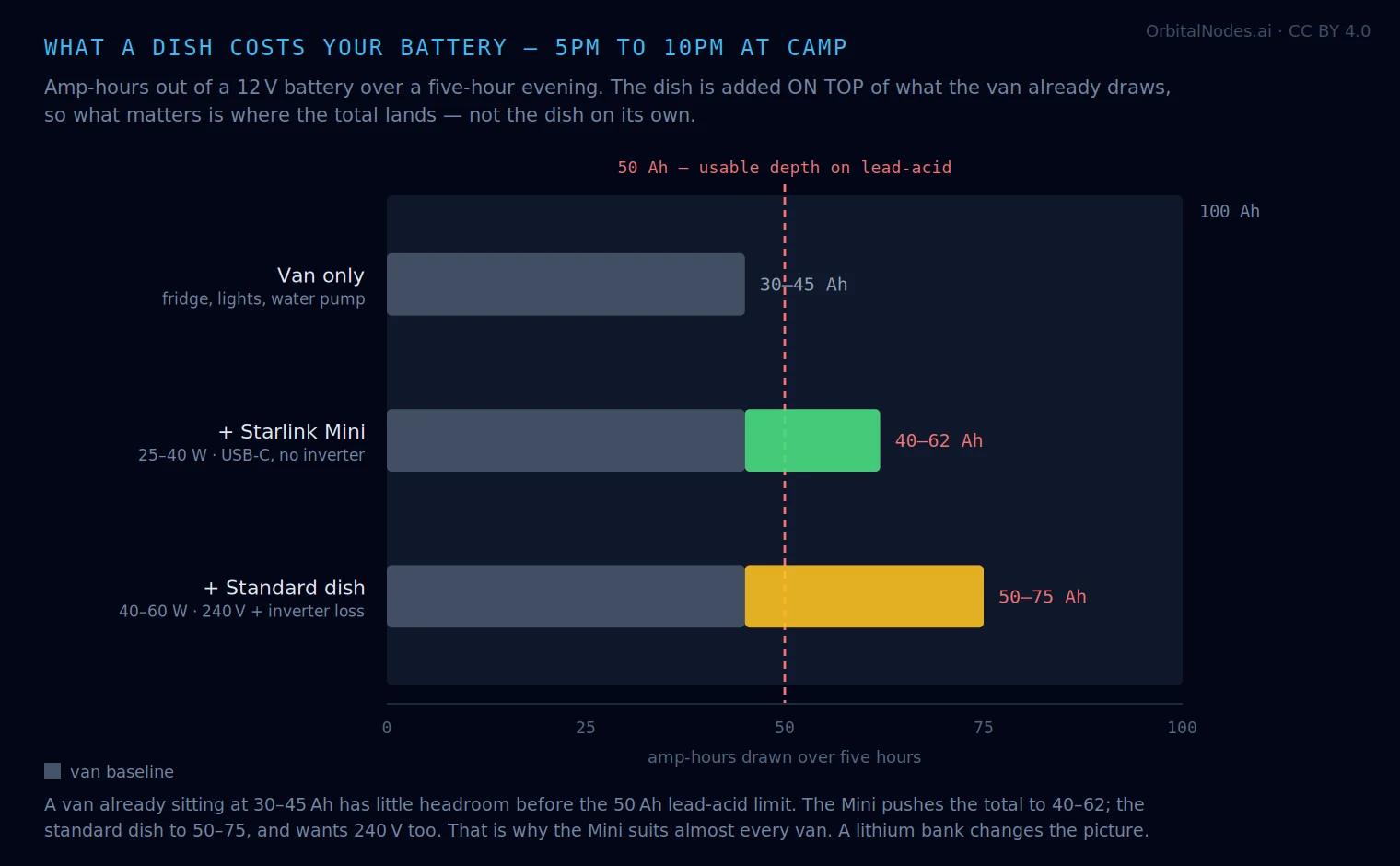
The Mini averages 25–40 watts. Run it from 5pm to 10pm at camp and that is roughly 10–17 amp-hours out of a 12V battery — noticeable on a single 100Ah battery already feeding a fridge, lights and water pump, and trivial on a big lithium bank. The Mini runs natively from USB-C, so no inverter loss. A standard dish draws 40–60 watts and wants 240V — nearly double the load plus inverter overhead, which is why the Mini is the right dish for almost every van.
This matters more than it used to because the vans themselves are getting bigger. BITRE’s registration data shows around three-quarters of newly registered caravans now exceed 2,500 kg tare — big vans, big fridges, big power systems. If you are speccing a battery bank for a new rig, budget the dish like you budget the fridge: it is a permanent evening load, not a gadget.
Sources. Power draw from SpaceX’s published Mini specifications (25–40W average) and standard-dish figures. Caravan tare-weight trend from Bureau of Infrastructure and Transport Research Economics registration data, 2025.
Where mobile still fails — the government’s own numbers
The reason satellite earns a place in a touring rig at all is that mobile coverage on Australian highways genuinely runs out — and the Commonwealth quantifies exactly where. Under the Mobile Black Spot Program, the government has funded up to 1,418 new base stations across eight rounds, generating more than $1 billion in total investment — and as at 30 April 2026, 1,202 of them are live. Rounds 6 and 7 are still being built through late 2026 and mid-2027, and Round 8 specifically targets disaster-prone regions.
Read that the honest way around: after a decade and a billion dollars, the black-spot list still is not finished. Every one of those 1,418 sites is a place the market would not cover on its own — and the gaps between them are where your phone drops out and the dish earns its keep. The program’s public mapping tool shows funded sites near any route you are planning.
Source: Department of Infrastructure, April 2026. Base-station counts, round status and investment totals from the Mobile Black Spot Program’s published figures and FAQ. Site locations on the department’s MBSP mapping tool.
Carrier count in the towns along the big lap
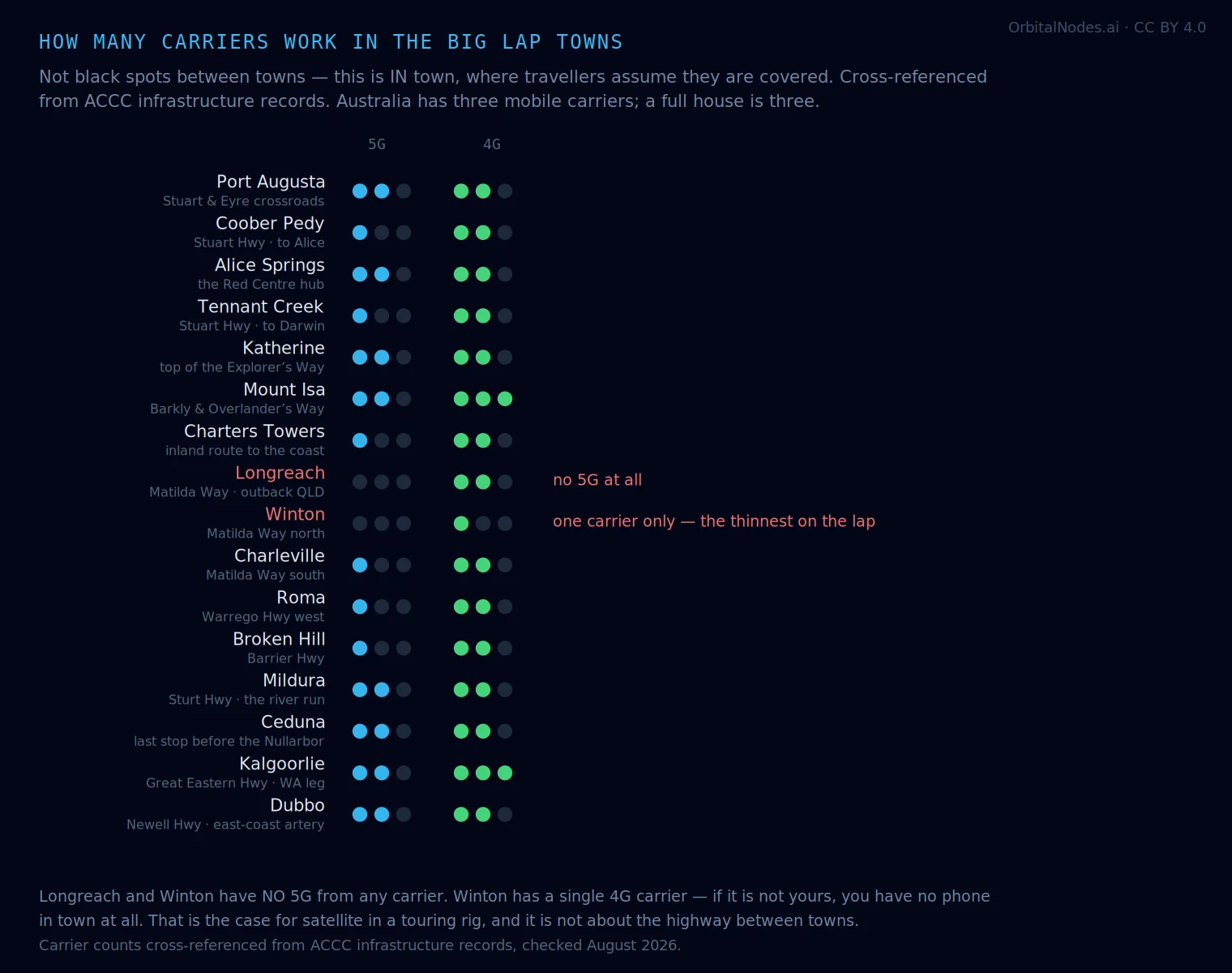
Between towns, coverage is the black-spot story above. In town, it varies more than most travellers expect — some outback service towns have no 5G from any carrier at all. This is our own verified data, from cross-referencing ACCC infrastructure records for every town we assess:
| Town | Route | 5G | 4G |
|---|---|---|---|
| Port Augusta | the crossroads — Stuart & Eyre highways | 2 carriers | 2 carriers |
| Coober Pedy | Stuart Hwy — Adelaide to Alice leg | 1 carrier | 2 carriers |
| Alice Springs | the Red Centre hub | 2 carriers | 2 carriers |
| Tennant Creek | Stuart Hwy — Alice to Darwin leg | 1 carrier | 2 carriers |
| Katherine | top of the Explorer’s Way | 2 carriers | 2 carriers |
| Mount Isa | Barkly & Overlander’s Way | 2 carriers | 3 carriers |
| Charters Towers | inland route to the coast | 1 carrier | 2 carriers |
| Longreach | Matilda Way — outback QLD | none | 2 carriers |
| Winton | Matilda Way north | none | 1 carrier |
| Charleville | Matilda Way south | 1 carrier | 2 carriers |
| Roma | Warrego Hwy west | 1 carrier | 2 carriers |
| Broken Hill | Barrier Hwy | 1 carrier | 2 carriers |
| Mildura | Sturt Hwy — the river run | 2 carriers | 2 carriers |
| Ceduna | last stop before the Nullarbor | 2 carriers | 2 carriers |
| Kalgoorlie | Great Eastern Hwy — the WA leg | 2 carriers | 3 carriers |
| Dubbo | Newell Hwy — the east-coast artery | 2 carriers | 2 carriers |
Carrier counts are the number of national networks (Telstra, Optus, TPG) with infrastructure serving each town. Each town name links to our full assessment — NBN mix, satellite verdict and what you can actually get there.
The pattern that matters for a traveller: along the Matilda Way, Longreach and Winton have no 5G from any carrier — 4G only, and outside town, often nothing. That is precisely the country where the dish stops being a luxury. On the Stuart Highway the towns themselves are reasonably served, but the gaps between them run to hundreds of kilometres.
Verified July 2026. Derived from ACCC telecommunications infrastructure records, cross-referenced per town by us. Full methodology on each town page.
The honest catches nobody puts on the brochure
Trees beat satellites. The classic caravan-park problem: a shady site is a blocked sky. Starlink needs a wide clear view, and the leafy sites everyone wants are the worst ones for it. The app’s obstruction checker is worth running before you pick a site — or carry enough cable to put the dish in the clear.
The Residential trap. Residential plans are cheaper than Roam but locked to a fixed address — they do not travel. If you got a free Mini with Residential Max, note that offer closed to new customers on 6 June 2026; existing customers are grandfathered. Touring means a Roam plan, full stop.
The two-month overseas rule. Roam works in 150+ countries for up to two months continuously — fine for a Kiwi loop, but a longer overseas stint means transferring your service region.
Data burns faster than you think. Streaming to the van telly every night will run through 100GB in a couple of weeks. Either budget it, or take Unlimited and stop counting.
Where to buy — matched to how you travel
Where to buy
How we make money: none of the links below earn us anything at the moment. If that changes, this note will say which do — and it will never change what we recommend, or the order options appear in. Starlink pays us nothing. Read the full policy.
Common questions — Starlink on the road
Does Starlink work in a caravan in Australia?
Yes — it is the standard setup now. A Mini on Roam 100GB ($85/mo) covers the van parked anywhere in Australia with clear sky, and Standby ($15/mo) parks the plan between trips. SpaceX estimates Roam at 65–260 Mbps down — at camp it performs like a good home connection.
Can I use Starlink while driving?
The grey zone: Roam advertises in-motion support to 160 km/h and travellers report it works, but Starlink’s customer information for standard portable dishes says the service may not be used while the dish is in motion. Since March 2026 Standby also cuts out above 16 km/h. Parked use is unambiguous; underway use is at your own risk on standard hardware.
How much power does Starlink use in a van?
The Mini averages 25–40 watts and runs from 12V via USB-C — roughly 10–17 amp-hours over a five-hour evening. A standard dish draws 40–60 watts and wants 240V. For battery-powered vans, the Mini is the right dish.
Is Starlink better than my phone for travelling?
They do different jobs. Mobile covers the drive; Starlink covers the camp — especially beyond town limits, where the government’s own black-spot program shows coverage still is not finished after 1,400 funded towers. Most serious travellers run both.
Will Amazon Leo work for caravans?
Not at launch. Amazon Leo’s initial Australian service is residential/fixed via its NBN partnership — no portable or roaming product has been announced. Starlink Roam is the only game on the road for now; treat Leo as a later chapter.